I have a painting that I have never liked and I thought I would try to do something new with it to salvage it somehow.
Here is the original painting:
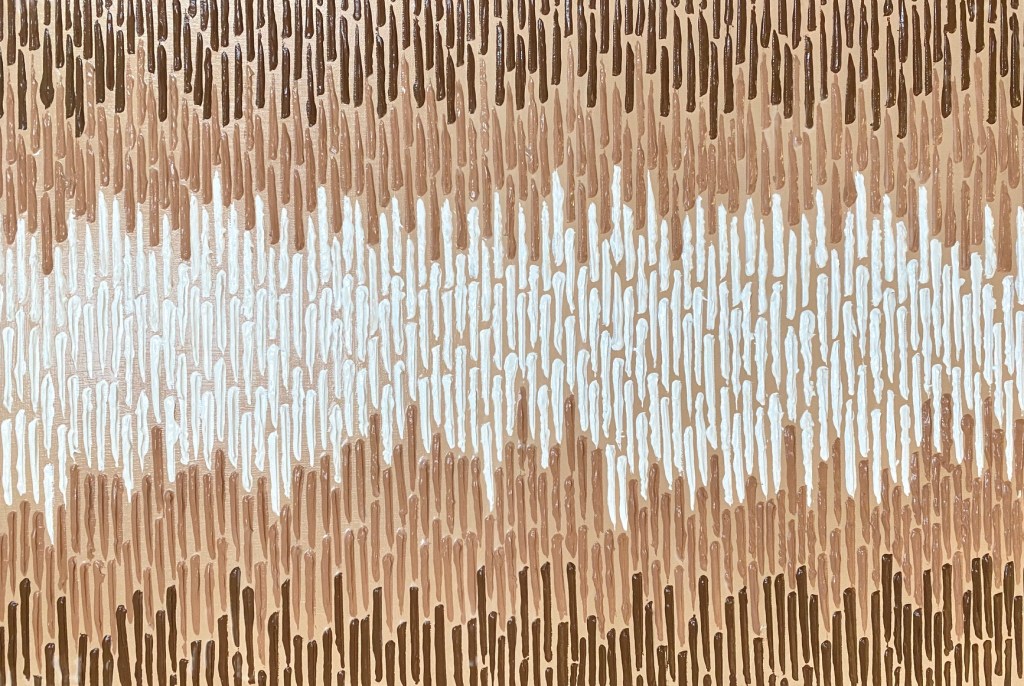
The piece is acrylic on box canvas, size 70cm x 50cm. I used my own method of laying the paint using a bamboo skewer stick, where I dip the stick into the paint and roll it onto the canvas horizontally. I have used this method for a number of other paintings quite successfully but where I mix different colours in each application of paint, eg:
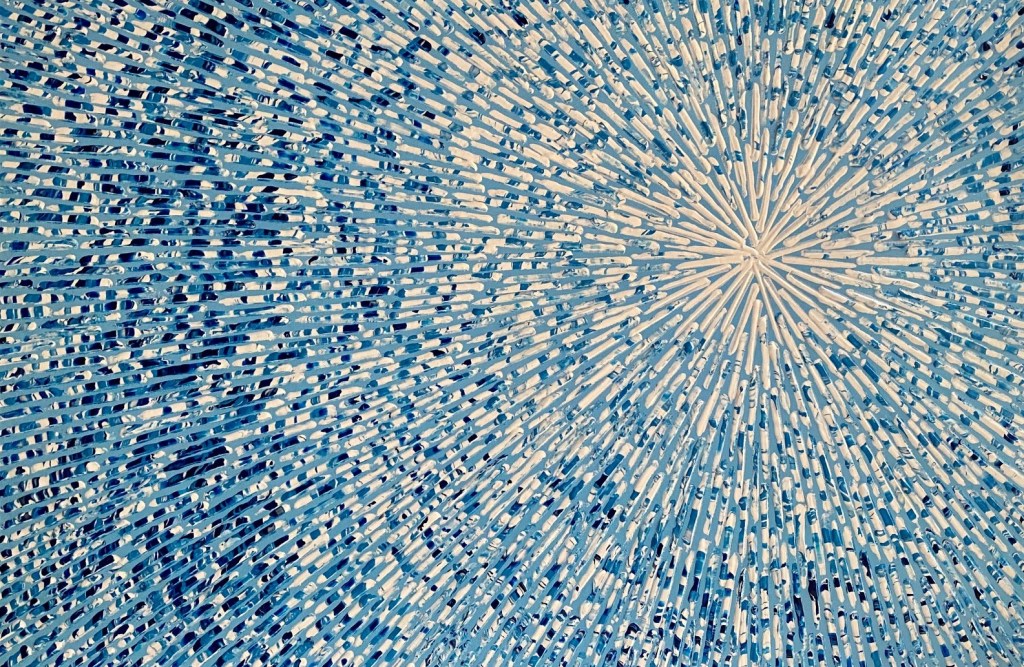
However for the piece in question, I decided to lay solid lines of colour. I had also wanted to try some more neutral tones since most of my colourful paintings are in blues and greens. I was hoping to appeal to potential clients whose homes were more neutral tones.
I peddled the original piece at several art shows and exhibitions, but never got much interest, and I think that was in part because I didn’t really believe in it, so couldn’t “sell” it very effectively.
(Honestly I am terrible at selling my art anyway because I find the process excruciating! I find it difficult to speak confidently about my art because I haven’t felt confident in myself as an artist. However I’m starting to feel that change. Hmm perhaps this could be a new subject for a blog post coming soon!)
I’m not sure if it is the colour combination, paint application, distribution of paint, or what, but this painting was not one that I was proud of. I think applying the paint in solid blocks is just not as effective or eye-catching as when there are multiple colours in each application of paint, as in the blue painting above.
So how to “amp up” this piece? I stood and looked it for a while, turning it in different ways. Should I add more lines of paint? Add more colours? Add some white? (I do love white.) I remembered that I have some metallic leaf in the art room somewhere and maybe I could use that. I have gold, copper, and silver leaf. Yes of course I’ll use the copper leaf, having never done any kind of metallic leafing ever, but surely I’m an artist and I can make it work.
Hmm, it was trickier and a lot messier than I thought. I applied the adhesive liberally but concentrated more on the outer areas, and put much less on the white areas. When it came to applying the copper leaf, it was challenging to apply the right amount and to get it to stick properly to the adhesive. When it came to brushing off the excess leaf from the painting, I underestimated how far that stuff could travel. It seemed to float around the art room and made quite a mess.
I’d like to say that I got carried away by the process and lost myself in the joy of creating, but that would not be true. I did lose track of time, but mostly because I was concentrating on trying to make it work and not making so much mess, both of which I think I failed at.
Here is the resulting piece:
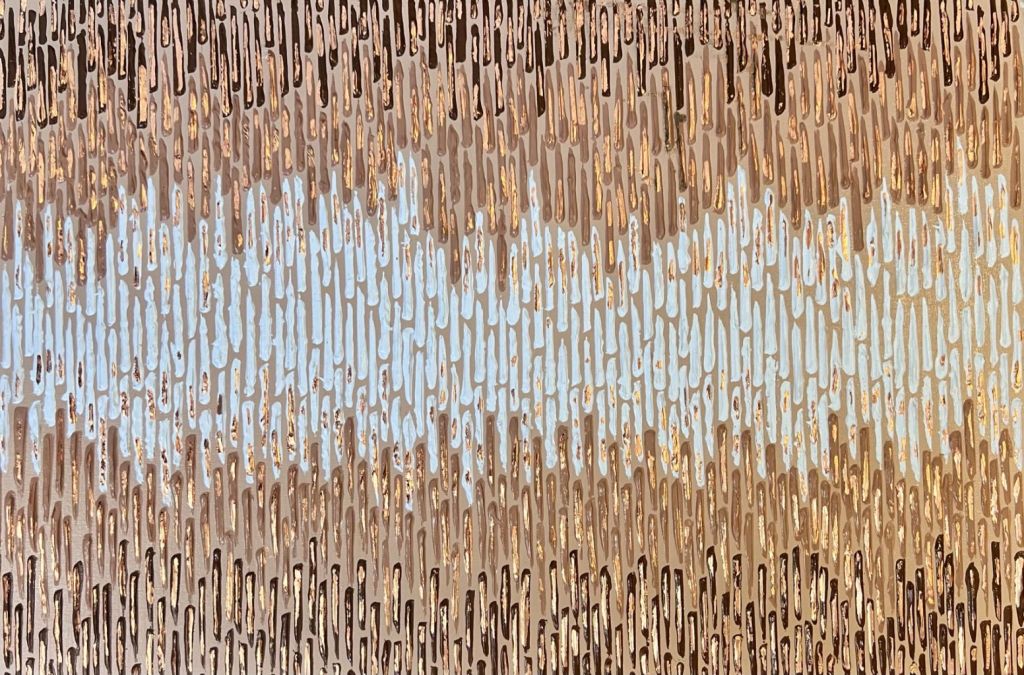
It is not easy to see in the photo, but I think you can tell where the copper leaf was applied and it does look different and more interesting than the first version.
The leaf works best on paint that is a contrasting colour. It doesn’t show up as well on the paint that is too similar.
Looking at the painting objectively, I still don’t really like it and don’t think I’ll be taking it to any shows any time soon. I did learn a lot about applying the metallic leaf and think I will try it again on a different painting to see how it goes.
In the meantime I will continue cleaning up tiny bits of copper leaf from every nook and cranny in the art room…
 Sophie Ashdown
Leave a comment