This week we were tasked with bringing to the session a piece of writing that inspires us in some way.
As I am still thinking that Constructivism will be part of the my Study Statement, I thought I would find something that related to it. I should not have been surprised that it was quite challenging to find a piece of writing about Constructivism that provided some inspiration. Much of the text about this art movement is somewhat austere and/or technical in its description.
Thankfully I came across an article from the Guardian from February 2009 by Adrian Searle. He wrote a review of Tate Modern’s exhibition “Rodchenko and Popova: Defining Constructivism.” It was an exhibition of the works of Alexander Rodchenko and Liubov Popova, two of the founder members of the Constructivist movement in Russia in the 1920s.
The exhibition was clearly an excellent example of works by these two artists that reflected the Constructivist ethos and aesthetic. What I found inspiring was how Adrian Searle wrote about it so enthusiastically.
Here are some excerpts from the review:
“How energetic and optimistic a movement Russian constructivism was. Even at its most formal and austere, there is a verve and a dash about it. Paintings come at you on the tilt, as if sailing before a high wind. Typography barks and shouts. Every gesture is an exclamation, and everyone is going geometric. This is a brave new world. Kiosks are all jaunty angles and out-of-kilter balconies, though heaven knows what you would buy in them. The architecture would make you too giddy to think.

In Popova’s earlier paintings, bars cross the surface as though they were in a great hurry to get somewhere. Her percussive rhomboids have all the emphasis of a hand slamming a desktop. She mixes metal dust and sawdust into her paint, giving her forms extra oomph and weight. Sometimes these experiments give her work a weird, lumpy tactility. At other times, it is as bright and unexpected as a chaffinch. You can lose yourself in her paintings’ complications.
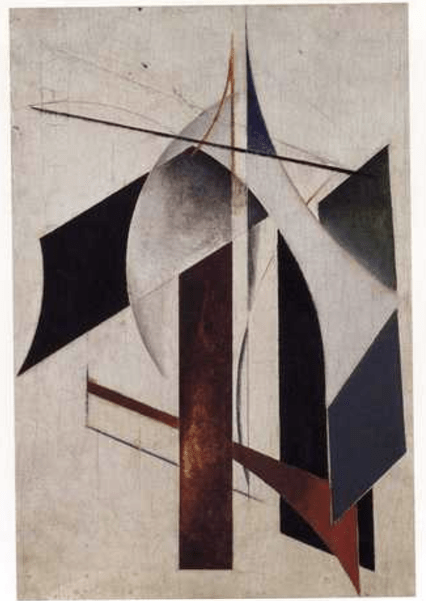
In Rodchenko’s works, lines take decisive turns, ricocheting back from the edges. There are flat, eclipsed discs, with penumbras of light. His shading is insistent, as if daring you to doubt. Rodchenko could turn his hand to anything, and would adopt whatever artistic position was necessary at the time. I wonder if the two artists, working at the service of the new state, knew how good they were, and how prophetic their paintings now seem to be.
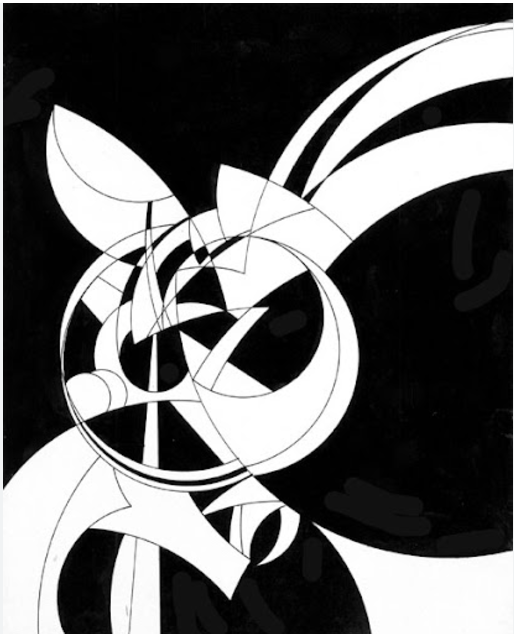
Rodchenko produced his own black-on-black paintings, as well as black paintings overlain with scatters of little coloured dots, or a single diagonal cruciform shape. However much Rodchenko wanted his work to look machine-made, he had a very good sense of touch.
These very different works are made with the same conviction and confidence. All, in their way, are like premonitions of what painting was to go on to be, and to do, under quite different circumstances in the west, over the next half century or so. There are paintings by both Rodchenko and Popova that would not look out of place in a show of young painters now. They are full of ideas and implications which other artists have laid claim to and are still working through.
Constructivist art aimed to have the same status as verbal language; it wanted to be clear, rational, free of narrative or metaphor. I cannot think how many painters have since returned to this zero-degree of painting. It has become almost a rite of passage.
The paintings and designs in this show are astonishing.
It would be a mistake to see constructivism reduced to nothing more than a style; it was much more than that. It’s exhausting, and confusing. So, too, I suppose, was the revolution.”
I love the energy and vibrancy that Searle brings to his descriptions of the works and the Constructivist movement. It is such a niche movement that I am often the only one in a room that is excited about it, let alone even knows about it. So to hear someone describe it so vividly and passionately makes me feel more passionate about it. This is a refreshing feeling in a way. I am more energised and excited about my Study statement as a result.
I certainly hope that someone has even a tenth of vigour when describing my next show!
After sharing my piece of writing with my small breakout group, we reviewed and discussed others’ inspirational texts.
Cat described a piece of writing about Druidry which is really a manifesto of the Druid way of thinking, being, loving, and acting. It is a lovely description of gentle but passionate people. Cat certainly fits into that ethos as she is such a lovely person who embodies to beautiful faerie-like characters she creates.
Zoe read out to us a piece about refugees and how they are really heroes in what they have been through and deserve to be treated better. Zoe shared a very personal story about her family that was very moving. I wanted to reach through the screen and hug her. Truly we never know what immense challenges people have faced in their lifetimes just be looking at them. I applaud her tenacity of spirit and her dedication to preserving memories of her family.
Cheng share the lyrics of a Chinese song by Wu Qingfeng called Dance of the Gnomes. In particular we talked about references to Dodos, the extinct flightless bird. We discussed the concept of being a “joyous other” and what that meant. We all had different versions of the same idea. I loved the concept. Cheng shared a digital art piece she made as a nod to the song, featuring colourful dodos and beautiful flowers, including some lyrics from the song.
There is something endearing somehow about being a “joyous other.” I imagine it to be where you feel like you don’t quite belong among everyone else, and yet you are joyous in being that way. What a wonderful way to experience the world.
 Sophie Ashdown
Leave a comment