This week was a really good Tuesday session. Well all of them are good of course, but I particularly liked this one because we reviewed details about key dates coming up, the Study Statement due in February, Unit 1 Assessment, and the 1st year MA Interim show. It is likely related to how I think, but I like to know and understand what is coming up and what is expected of me. Truthfully, almost all of the information imparted during the session was already available online, but for some reason it sinks into my brain better when vocalised and discussed rather than just reading the text.
Jonathan explained about how he likes the course to run. One of his statements was that he tries to “create a sense of rhythm in the course that helps us to find our own rhythm.” I like this a lot as it helps me to set my own schedule and structure that works for me, within the overall framework of the course. He talked about how the pacing of the term makes things more or less intense or have more/less focus depending on each person and what is happening. He talked about “creating enough structure but also flexibility for us to find what works best.” And “trying to find the balance between structure and freedom.” I really appreciate Jonathan’s style of encouraging and developing us at artists. It must be working since I feel more inspired to be creative than I ever have.
We reviewed the key dates coming up. There is a lot happening this term!!

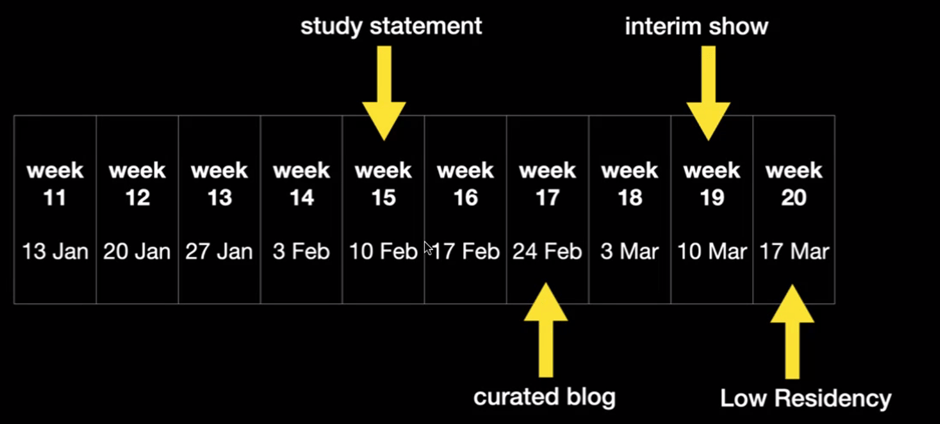
I am really excited about the interim show in March. There was a zoom call on Wednesday at 2pm with Alex the program director. I dialled into the call and found it very informative. I have been giving a lot of thought to what I want to contribute to the show. I don’t know how many pieces I can submit and what size, but I’m considering the options. One option is to have a a whole bunch of A5 size cards with different patterns in each. I’ve been making quite a few of these small patterns recently and I think it could be impactful to have a whole collection of them. I’m also thinking of doing some A3 size pieces of patterns in a constructivist style but I’m not sure how many I could include in the show. I’m also not sure yet about framing. I like to frame my pieces as they look better but if they end up being in the centre area without walls, then I’m not sure how they will display. I still have time to think about the show and will likely email Jonathan to get his input.
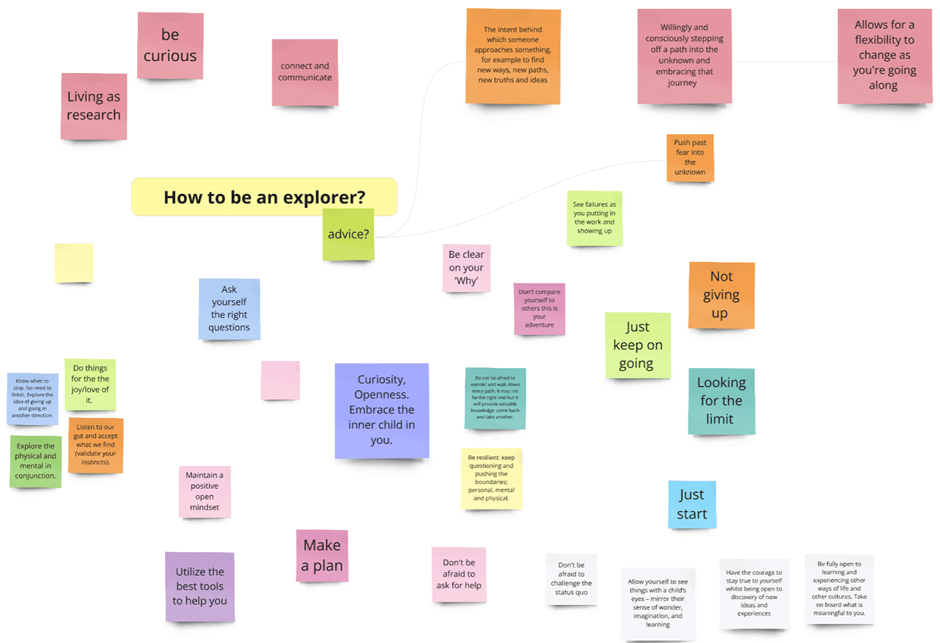
After discussion about the key dates we discussed “How to be an explorer?”
We were asked “What do you think of when you hear the word “explorer”?” I think of someone who has an open mind who seeks out new experiences and ideas, someone who is willing to push their own boundaries of knowledge, comfort, familiarity to discover new and exciting interests, knowing that sometimes they will find the most wonderful things and sometimes might not like what they find.
We then split into groups and asked to prepare three statements about “What advice would you give yourself as an explorer?” Here are some bullet points of things we discussed:
- Let go of your limitations
- Be completely open to new experiences and ideas
- Not too much worries
- Reading books, different cultures
- Search for new things
- Reflection
- Look for challenge
- Think like a child
- Be like a sponge
- Allow yourself to absorb
- Fight enemies, be rebellious, be a warrior
- Challenge
- Listen and look at other ways of life. Take what relates back to you
We then contributed four post-its on the Miro board for this topic:
- Don’t be afraid to challenge the status quo
- Allow yourself to see things with a child’s eyes – mirror their sense of wonder, imagination, and learning
- Have the courage to stay true to yourself whilst being open to discovery of new ideas and experiences
- Be fully open to learning and experiencing other ways of life and other cultures. Take on board what is meaningful to you.
We had a good discussion amongst the whole group about the different pieces of advice. A key point that resonated with me that we shouldn’t “just explore to reaffirm what we already know.” I think a lot of people across the world would benefit from that advice. It seems like social media just serves to strengthen the beliefs of people, without offering wider perspective that challenges that thinking.
We then discussed the Learning Outcomes that are expected of us from Unit 1. We will be assessed on this in February. Interestingly Jonathan said that he “doesn’t want to ask us to do anything that he thinks won’t be useful to us as part of the course.”
Here are the dates:

Here are the Learning outcomes for Unit 1:

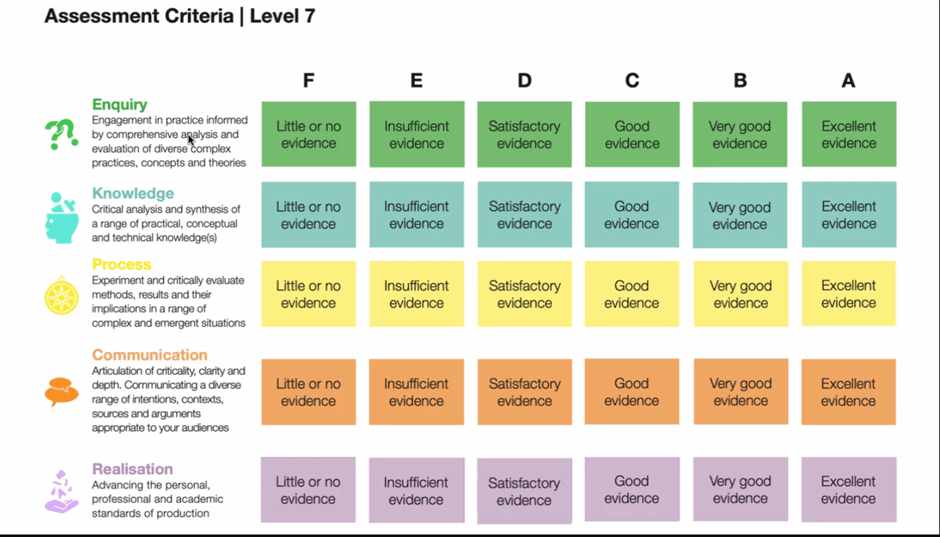
The standard assessment criteria is available online https://www.arts.ac.uk/assessment
I have thought a lot about the Study Statement but I hadn’t thought enough about my blog and whether it will fulfil the criteria expected. I don’t want to frantically write ten blogs the week before the assessment but I will certainly try to step up my game in the next few weeks. I will need to curate my blog posts to demonstrate how I’ve achieved the learning outcomes. I think it will be really interesting to take the time to reflect back on what I have thought and felt so far.

Jonathan says that the Learning Outcomes are the most important elements to focus on. We were challenged to focus on the Learning Outcomes in groups and rewrite them.
My group was given the second learning outcome:

Here are some notes I took during the discussion:
- Implement appropriate working methods
- Think about environment to be working in
- Have a plan
- Understanding how to do the work or achieve the objectives in the best way that works for each individual
- Set clear goals and directions for your research
- Create a work schedule with specific milestones
- Regularly monitor and evaluate your progress
- Be flexible in adapting your methods to changing needs
Unfortunately we ran out of time to really rewrite in the best way but we discussed and structured this:
- Know what kind of materials you will be needing, what is your methodology/plan. Create an independent environment and structure where everything is organised enough for you to be create your work and do your practice based research where people can engage and evaluate your art practice.
We discussed the Study Statement further. Jonathan said that it needs to be useful for me, in whatever form it takes. There is no word count. I need to think about it a lot more and work out what I need to do.
Jonathan thinks learning outcome number 2 is the most amount of work, and advises that we focus more on this LO more than the others overall. Some questions to ask myself:
- Have I found independent learning?
- Is this enabling critical engagement?
- What does practice-based research mean to me?
Critical engagement is the reflective process. I need to tell myself the story of my art practice.
I’m aiming to prepare a draft of my Study Statement this week, so we’ll see how it goes.
So overall the session gave me a LOT to think about this week!
 Sophie Ashdown
Leave a comment