This week we considered the concept that all artists “steal” ideas from other artists. The concept that “Nothing is Original”.
We watched a video featuring Austin Kleon who makes poems by selecting words from a newspaper and blacking out others to form the text. As he published the poems online and produced a book he was accused of plagiarising the work of Tom Philips. But it turned out the Tom Philips got the idea from another person historically who also got the idea from someone else.
Tom Philips – https://www.tomphillips.co.uk/humument
The concept is at first alarming to think about, but then you realise that of course it is true. In a way it has to be true because we all have to learn how to create our art from someone/somewhere in the first place, then what we make is how our brain has extrapolated what we have learned or seen along the way, then converted it into what we think is our own idea. The true could be said for musicians, novellists, and architects.
Picasso said that art is theft. “Good artists copy, great artists steal.”


Quote from Kleon:

It is an uncomfortable truth to realise. We don’t want to be seen as thieves or plagiarists, and for the most part I don’t think that’s what most artists are, unless they are directly copying or forging another artist’s work. I couldn’t make a copy of the Mona Lisa and try to sell it as my own original idea. My art career would be very short-lived I suspect.
Then we considered the concept that artists are collectors. We collect from our experiences, what we’ve seen, what we’ve felt, what we have, or what we wish we had, then turn that into some kind of output.
I am heavily influence by many famous artists – Bridget Riley, Wassily Kandinsky, Piet Mondrian, Robert Delaunay, Ellsworth Kelly, Alexander Rodchenko, etc. I’m sure there are elements of their work reflected in mine. And that is okay, provided I don’t make a direct copy of their work (much as I’d like to – I have a signed print of Bridget Riley’s Blaze Study in my house which is probably my most prized possession. If my house catches on fire I’m getting my kids, my cat, and that picture out first!)
We were asked to think about what we love and what we pull in to our life, our creative life.
I love the people around me the most – my family, my partner, my friends, and also the cat the most in the world. In my creative life I am constantly pulling in ideas, images, and thoughts. I look for interesting shapes and patterns wherever I find them which can be directly from other creative sources like fabric, paintings, drawings, etc but also from the world around me generally. The structure of a building, the pattern of a fence or brickwork, lines on the road, or from nature like the veins of a leaf, ice patterns, etc. I have hundreds of photos on my phone of random patterns I’ve seen while walking about.

We broke into groups (I was with the lovely Josh and Nicola) and discussed the above questions.
- We talked about things that influence our work. We are creatively charged people.
- Collecting come naturally, unconsciously noticing and collecting ideas and influences from around us.
- Useful to write everything down
- If it’s your “job” to collect then you’d be more organised and intentional. Also more specific in what you’re looking for.
- Manifestation of ideas. When you’re thinking about something or doing something you are more likely to notice it around you.
- Collecting is about things that are connected that bring joy. Hoarding is more about fear, about not throwing things away because you “might” need them one day or can’t bear to see them go.
- The more time spent processing something, the more it gets embedded in your brain/thoughts.
In the main group we talked about how relationships with others affect who we are. People naturally tend to surround themselves with people who are similar to them. Apparently we become the average of the five people who are closest to us.
We were asked about what could “disrupt the average”
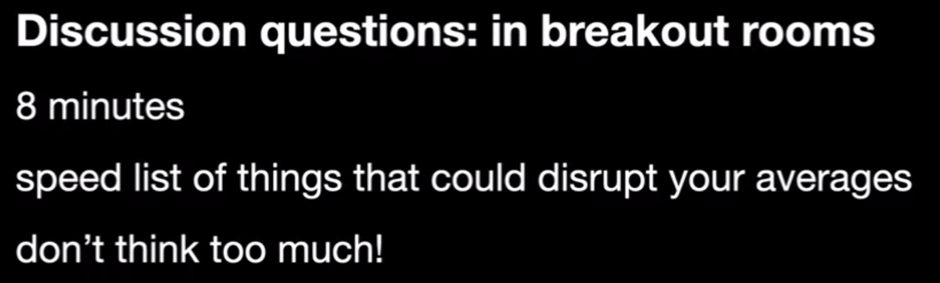
In our group we discussed the above:
- This course disrupts the averages. We are all from different backgrounds, cultures, areas, lifestyles.
- Volunteering
- Get a new job
- Some people are more inclined to expose themselves to different environments than others. We have all done this in this course.
- Join a book club. Experience people and books that you might not otherwise engage with.
- Different art groups. Doing exhibitions.
- Children
Josh said that “Growth doesn’t exist in comfort” which I think is quite a profound statement. I’m going to remember that one.
One of the nicest slides we looked at was this one:
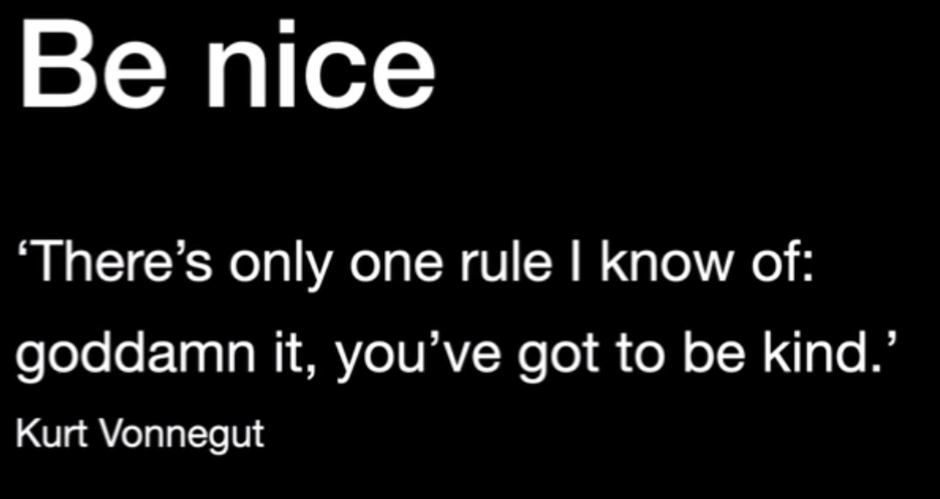
I hope I live my life as a nice person who is kind to others – both people and animals. The world is certainly a better place with kind people in it.

As a wider group we discussed the above. Some advice I would give myself would be:
- Play uplifting instrumental music that keeps you going but isn’t distracting
- Carve out enough time to get everything done
- Minimise distractions – eg. put your phone in another room
 Sophie Ashdown
Leave a comment