Jonathan introduced the concept of a description of art as a “turbulent storm of potential meaning.” That resonated with me where the emphasis isn’t on delivering a single clear message, but on creating something interesting enough that the viewer can find multiple meanings.
This is something I’ve actually experienced before in my work. Some of the pieces people respond to most strongly are abstract works where viewers project their own interpretations.
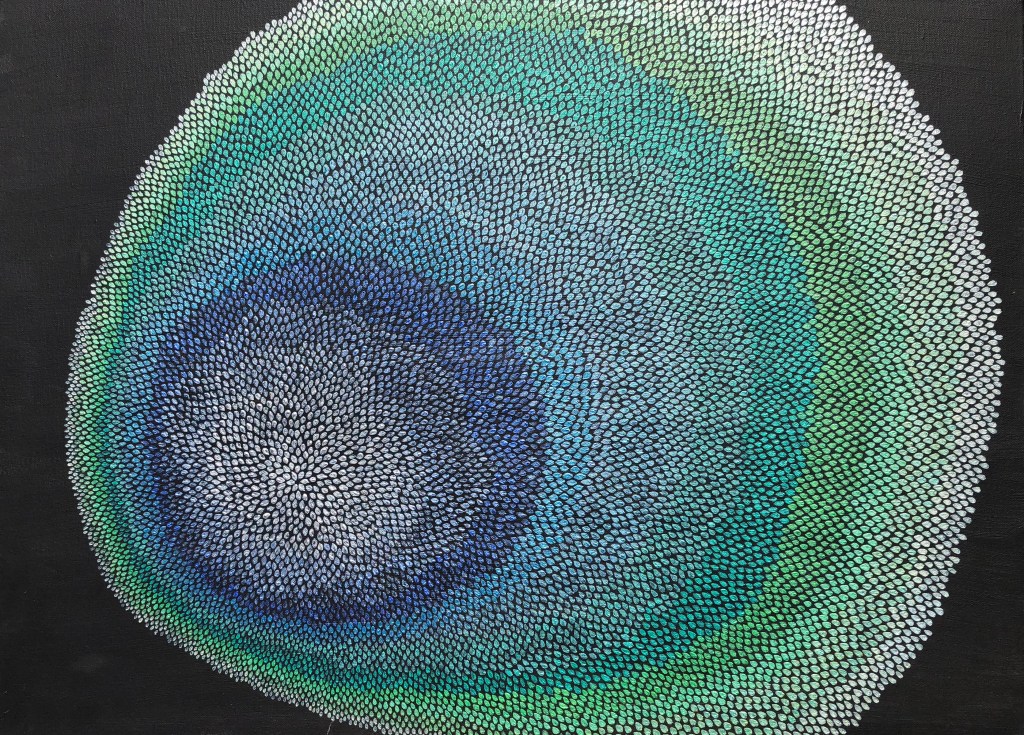
I had a particular piece where people saw different things such as an eye, a tunnel, a shell, an eye, amongst others. I found these different interpretations fascinating and made the piece more interesting as a result.
I know that with my data pieces, I want viewers to see the work as an engaging piece of art on its own, even if they don’t know that it is based on date. I want them to interact with the work visually and emotionally first, and only later discover that it relates to a set of data or patterns beneath the surface.
We also discussed what I call the “blue painting” based on working from home data. The differently shaded rectangles represent the data, but by layering acetate over some of the shapes it gives a very different message. I could use the layered acetate in other work or do more collage pieces to add further interest and engagement.
What I realised is that some of these experiments are useful because they are low-risk. If I’m not particularly attached to a piece, it becomes a perfect opportunity to play, test ideas, and see what happens without worrying too much about the outcome.
This possibly feels like an important shift in my approach. I know I’ll never be a free-wheeling artist because precision, structure and planning are part of how I work, but maybe I can find more opportunity for interpretation and exploration.
 Sophie Ashdown
Leave a comment